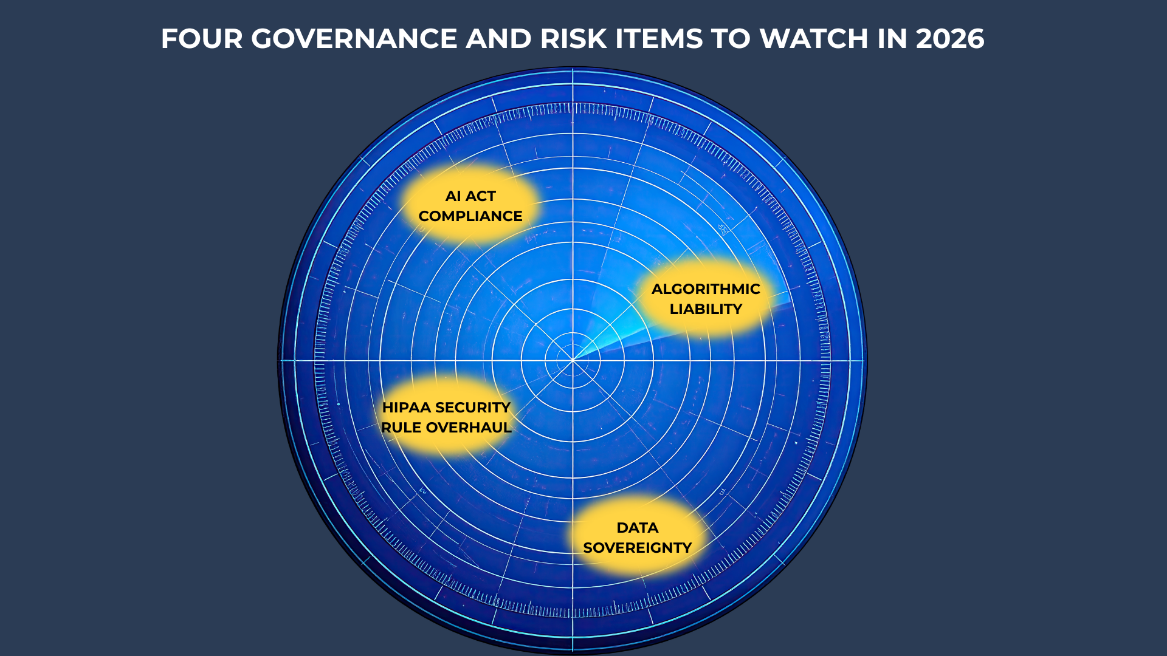
This article highlights four areas that might not yet be on your radar for 2026. If they seem like threats or opportunities, you may want to elevate one or more of them to your strategic planning discussions for 2026.
1. The Global AI Act Compliance Cliff
The first is the European Union Artificial Intelligence Act Compliance Cliff. The EU moved ahead of the world on regulation of AI by enacting the Artificial Intelligence Act in 2024. The EU AI Act applies a risk-based approach that bans "unacceptable" practices—such as social scoring and predatory behavioral manipulation, and also requires strict transparency and safety standards for "high-risk" systems such as those used in healthcare.
So why might the EU AI Act apply to U.S. companies? Because of its extraterritorial reach. If a company’s product or service is sold or licensed in the EU, or if its output is used by anyone in the EU, these rules may apply. The penalties for non-compliance can be severe: up to €35 million or 7% of global annual revenue. This equation is the “greater” or “lesser” of depending on company size. Note that August 2, 2026 is the compliance date that applies to most high risk clinical AI systems—for example, diagnostics, triage tools, and decision support systems.
If you are marketing AI or its outputs in the EU, think about forming an AI Governance Board that is multi-disciplinary—for example including representatives from legal, clinical, and compliance—to oversee your go to market activities. If audited, it may be necessary to prove that you are capable of logging model versions, performance, and producing a full audit history.
2. Algorithmic Liability
Second, algorithmic liability and bias litigation is emerging as a high risk area. The legal landscape is quickly shifting to hold technology providers responsible for adverse patient outcomes caused by biased AI. For example, an algorithm trained on data that underrepresents women or minorities can lead to systemic misdiagnosis. The era of simply accepting without question opaque, "black box" technology may soon be over.
If this risk applies to your company, you might consider pre-deployment testing that includes rigorous bias risk assessments to prove performance equity across all demographic groups. Also, look at your vendor contracts. You should require strong indemnification clauses and may want to require that vendors provide a so called "Model Card" that describes the training data and known limitations of their systems.
3. The HIPAA Security Rule Overhaul
The third item to watch is the HIPAA Security Rule Overhaul, which might be finalized and take effect in 2026, although there has been industry pushback and it may be delayed. The overhaul is mostly about making the HIPAA security measures mandatory, not addressable. The proposed rule dispenses with "addressable" standards to adopt only prescriptive, required security measures.
Health Tech companies may need to invest in the following three areas, among others, which are becoming mandatory:
The compliance risk is that non-adherence to these specific new mandates may make it easier for plaintiffs to prove negligence in the event of a breach. This moves the HIPAA Security Rule from a self-attestation model to a verifiable, empirically testable standard that can be cited by plaintiffs in litigation.
4. Data Sovereignty and Supply Chain Risk
Finally, data sovereignty and supply chain risk arises from the movement toward requiring data to be hosted and present within local jurisdictions as a compliance or risk management matter.
Consider treating data localization as a comparative advantage and not just as a compliance box to check. For example, you may consider conducting a comprehensive Third-Party Risk Management (TPRM) audit that validates your security measures.
Also, business associate contracts may need to be updated to require vendors to notify covered entities of a security incident or breach within tighter timeframes, as little as 24 hours. Global companies may consider investing in sovereign cloud architectures that embed the adherence to local laws directly into the technology, to demonstrate more robust controls.
In 2026, there may be some competitive advantage for companies that manage one or more of these four risks proactively.


It was at the top of the list of healthcare regulatory developments for 2026. The Change Healthcare meltdown in 2024 and a spate of ransomware attacks lit a fire under HHS and the industry to tighten up the HIPAA Security Rule.